
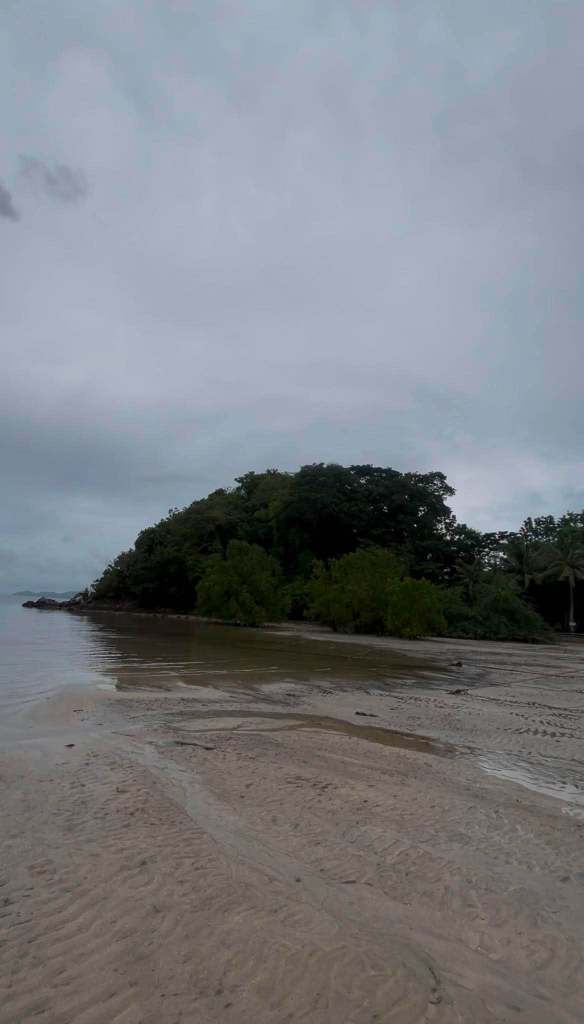
Based on oral traditions, we were taught that Batacalan was the old name of present-day Barangay Villa Paz. However, historical records indicate that the pre-colonial center of Batacalan was actually located in present-day Sitio Santa Monica, Barangay Sibaltan.
Batacalan was the name of a Tagbanua trading community situated in what is now Sitio Santa Monica. The settlement started in the 6th Century AD and was large enough for the Spanish colonizers to recognize it as a pueblo (town). Moreover, the abundance of pre-colonial artifacts discovered in the area suggests that it may have been even larger before the arrival of the Spanish. As was customary in newly acquired territories, the Spanish renamed the settlement Santa Monica, a name that survives today as the name of the sitio. However, Batacalan’s dominance had already begun to decline by the time the Spanish arrived.
As Batacalan declined, another Tagbanua trading community, Talindac, rose to prominence during the sixteenth century. It originated in present-day Sitio Langeb-Langeban, Barangay Aberawan, before later transferring to present-day Cabigsing in the town proper. Just as they had done with Batacalan, the Spanish gave Talindac a new name – Bacuit.
When Talindak became an independent pueblo from its former status as a visita of Taytay in 1888, additional barrios were needed for the new municipality. At that time, a visita was roughly equivalent to a barrio, although the two differed in administration: a visita was governed by friars, while a barrio was administered by civil authorities. At the time, Talindac and Batacalan were the only visitas within the proposed territory.
Eventually, these two visitas were divided to create three barrios under the new pueblo. Talindak was split into Talindac and Bacuit. Talindac became the capital, located in the present-day town proper, while Bacuit became a barrio centered on Talindac’s former site at Langeb-Langeban. Batacalan was likewise divided into two barrios: Santa Monica, centered in present-day Sitio Santa Monica, and Batacalan, centered in present-day New Ibajay and Villa Paz. This division explains why many people today associate Batacalan with Villa Paz.
From that point onward, historical records listed the barrios of Talindac as Bacuit, Batacalan, and Santa Monica. By 1900, the recorded barrios were Bacuit, Tenguiban, and Batacalan. In 1903, however, Sibaltan appeared in place of Batacalan, indicating that the name had changed.
According to accounts from the residents of Sibaltan, their grandfathers migrated from present-day Santa Monica – the former center of Batacalan – to present-day Sibaltan sometime between the 1890s and the 1910s. As the population gradually shifted to Sibaltan, the community’s center also moved, which may explain why the name Batacalan eventually disappeared from official records and was replaced by Sibaltan.
What happened to Batacalan? How did a thriving trading community large enough to be recognized as a town become merely a sitio today?
One possible explanation lies in the changing coastline. The receding shoreline suggests that the principal ports were once located at present-day Santa Monica and Langeb-Langeban. The mudflats that now lie in front of these areas may have been deep-water channels leading to harbors a thousand years ago, capable of accommodating trading vessels. As the shoreline gradually receded, these ports became increasingly difficult to access.
Meanwhile, the harbor at present-day Cabigsing remained accessible to trading ships. As maritime commerce shifted there, so too did the local economy. Economic opportunity attracted migrants, causing the population to concentrate around present-day Cabigsing. With its growing population and expanding trade, the area eventually developed into the town of Talindac, which was later renamed Bacuit and, ultimately, El Nido.
What if the shoreline had never receded? Batacalan might have remained the region’s principal trading center – and it could very well have become the town at present.

