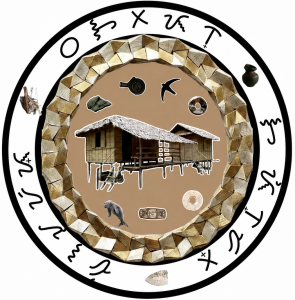
The Municipal Tourism Office of El Nido was involved in 11 cultural mappings in 9 barangays, namely, Sibaltan, New Ibajay, Barotuan, Pasadeña, Buena Suerte, Manlag, Mabini, Teneguiban and Villa Paz. The first involvement was in 2012, in support to the cultural mapping conducted by Lace Thornberg in Sibaltan. Another one in 2016 was in partnership with the University of the Philippines (UP) in New Ibajay. Out of 9 barangays only 6 have already finished formulation of cultural symbols. These symbols shall be used in destination branding, events designing and tour designing for the Community-Based Rural Tourism Program.
Cultural mapping is a tool to identify cultural objects, tangible or intangible, in a particular area. In this process, community members coming from the different sectors gather. There are farmers, fishermen, women, elderly, youth, teachers and barangay officials. They identify in the map the five categories used in the El Nido module, namely, places, people, practices, objects and structures.
Cultural mapping is used by several academic institutions and research groups. They vary in forms and patterns depending on the data needed by the institution handling it. Currently, the form being used in El Nido is the one introduced by Prof. Cecilia Dela Paz, PhD, Director, Office for Initiatives for Culture and Arts, UP-Diliman Campus.
Sibaltan: Balay Cuyonon
The first cultural mapping was introduced by Lace Thornberg in 2012 in Sibaltan. She used the system she learned from Dr. Cecilia Dela Paz. And it became the blueprint of all El Nido modules afterwards. The aim of that cultural mapping was to prepare for the establishment of a community museum that would house the artifacts unearthed during the Archaeological Field School hosted by the University of the Philippines’ Archaeological Studies Program in 2010 wherin Ms. Thornberg was a participant representing the University of Washington.
As the cultural mapping goes on, people of Sibaltan realized that they have a more important thing than archaeology, their cultural symbol as Cuyonons. They realized that their population was 95% Cuyonons and during the workshop, the group discussed the design of the traditional Cuyonon house that can no longer be seen in Sibaltan. Then, they decided to create a replica that could also serve as a museum.
After the workshop, Ms. Thornberg wrote a proposal to the United States Embassy in Manila for the construction of the traditional Cuyonon house. Normally, the Embassy does not fund infrastructure but since the traditional house itself is the exhibit, they granted the request for funding and in that same year, it was constructed. The people of Sibaltan called it the “Balay Cuyonon.” It became a symbol of the Cuyonon culture that visitors experience in the place.
New Ibajay: Caves of Dewil Valley
New Ibajay underwent cultural mapping 3 times. The first was in 2013, then, in 2016 and the last one was in 2020. In these workshops, the caves of Dewil Valley stood out as the most important symbol of the area. Dewil Valley has the most important archaeological and paleontological sites in El Nido: the rock formations of Ille, Istar, Diribungan, Idelet and Makangit.
Aside from Dewil Valley, cultural mapping also mentioned Domarakol, a Tagbanua epic that is still practiced by the Tagbanua communities in New Ibajay, Batas Is. (Taytay) and Malapaya Sound (Taytay). The epic talks about the heroism of Domarakol, a Bornean warrior who saved the Tagbanuas from the raiders of Sulu Sultanate.
The workshop also mentioned the practice of babaylans, the Filipino version of shamans. The participants identified that there were still Tagbanua, Illongo and Aklanon babaylans living at that time. Evidence of babaylan rituals was accidentally discovered by the team of Dr. Victor Paz in 2013 when they fixed the pit dugged by treasure hunters at Idelet Cave. There, they discovered a daga or wand used by a babaylan. Dr. Paz estimated that the daga was 80 years old already that time.
Manlag: Manla
The cultural mapping in 2020 revealed the rich history of Manlag as well its culinary traditions. During the workshop, Manla, a type of crayfish that lives in its mangrove areas, emerged as Manlag’s destination symbol. Historically, it is important since the barangay was named after Manla. It is also the core of their culinary traditions since it is very abundant in their mangroves.
Cultural mapping also discussed the origins of the names of places and islands such as Malapacao, Pungtod islands. Participants also shared pictures of old objects treasured by several families.
Mabini: Canovas Ruins
In Mabini, the Canovas Ruins stood out as the destination symbol because of its uniqueness and age. The ruins was the site of the 1st Sawmill in the island of Palawan. It was built by the Canovas family on April 3, 1923. They are one of the Spanish families living in El Nido during the 19th century.
During the workshop, the participants also discussed old houses, caves and the kitchen utensils and religious artifacts that were left by the Canovas. The participants also discussed stories evolving a mysterious rock.
Teneguiban: The Bell of Nuestra Señora del Salvacion
Teneguiban is home to 3 groups of people, the Tagbanuas, the Cuyonons and the Bisayas. Each group has its own fishing traditions and rituals. The cultural mapping participants also discussed wedding and burial traditions. The Tagbanua group described the design of Tigbaboy, their fishermen’s temporary shelter.
However, one cultural object stood out, the Bell of Nuestra Señora del Salvacion, it is a bell built in 1890 and was stolen thrice by treasure hunters.
Villa Paz: Puting Bato Cave
Cultural mapping in Villa Paz is different. It discussed more of its diverse wildlife in a forest where their destination symbol can be found, the Puting Bato (White Rock) Cave. This cave is different since it is made of quartz. It is a cultural symbol since it is a landmark and resting place for hunters in the past.
The participants talked about the different hunting spears and techniques. They also talked about several old tapayans (big jars) still in possession of several families. Tapayans were used by the Cuyonons for storing water and food in the houses or on board the traditional merchant ships called Pangko.
Unfinished Workshops
Cultural mappings were also conducted in Barotuan, Pasadeña and Buena Suerte but their destination symbols were still not finalized. The Municipal Tourism Office aims finalize the destination symbols of all 18 barangays for tourism branding purposes, formulation of tours and festival designing. This year, another 5 barangays shall undergo cultural mapping workshops to finalize their destination symbols.


Gathering all of these artifacts and cultures of different barangay will make us known not just for our beautiful islands [ island hopping ] but also to put El Nido in great heights in the field of heritage and history. Hope our Culture and Arts get more funding from our lgu and outside sources to identify and create more museums in every barangay to enhance our diversity in tourism industry.
LikeLiked by 1 person